Yearly AC Cleaning for Al Barari Residents
Most air-conditioning advice written for Dubai assumes an apartment or a standard villa. Al Barari is neither.
Two things make these houses different, and they compound each other. The first is scale: in the Al Barari villas we service, the typical property has around fifteen indoor air-conditioning units — most fall between fourteen and nineteen, and the largest we maintain has fifty-one. A villa in Arabian Ranches or The Springs typically has four. That is not a difference of degree; it is a different maintenance problem.
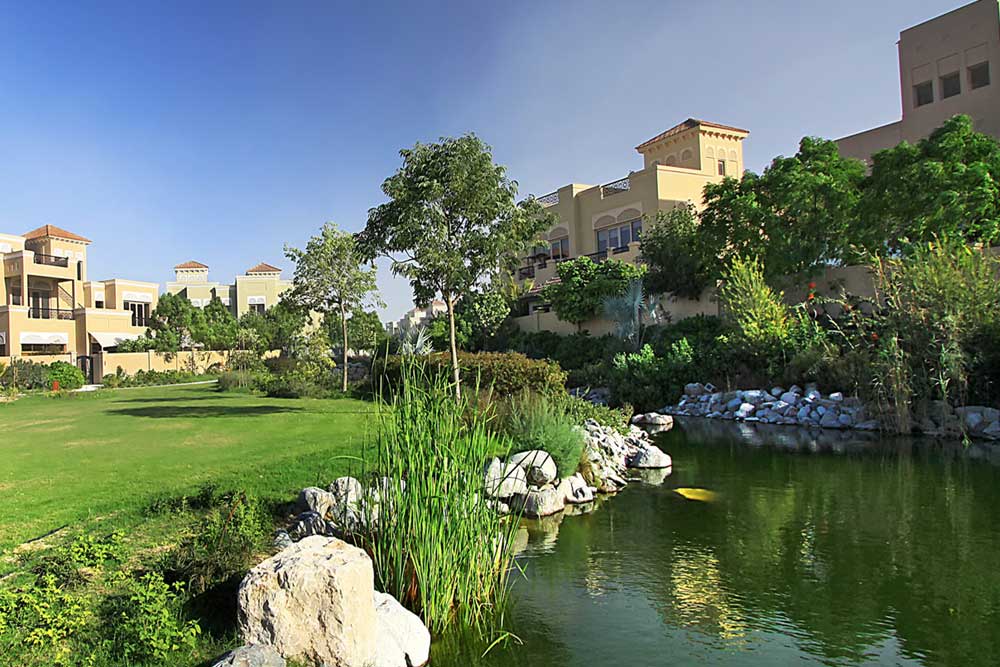
The second is the setting. Al Barari sits roughly fifteen kilometres inland from the Gulf coast and is built around mature landscaping, irrigated gardens and freshwater waterways. The developer describes a community where “more than half of its expansive 15.3 million square feet” is preserved as green space — elsewhere on their own site the figure is given as “over 60 percent.” Those are their published claims rather than anything we have measured, and they do not quite agree with each other; either way the direction is unambiguous, and it is why people live here. It also changes the air the system has to condition.
This page explains what that combination does to a cooling system, what we find when we open one, and what a proper yearly service involves at this scale.
The green setting is a comfort asset and a moisture load
This is the part most AC companies will not tell you, because it requires explaining rather than selling.
Dense planting and continuous irrigation add water vapour to the air around a building — through evaporation from wet soil and open water, and through transpiration from the plants themselves. In a community built around mature gardens and lakes, the air immediately around the house carries more moisture than the bare desert a few kilometres further out.
Your air conditioning has two jobs: lowering temperature, and removing moisture. Only the first one is on your thermostat. Here is why the second matters more here.
Take a summer afternoon at 38 °C with 50% relative humidity — plausible in a well-irrigated inland setting. The dew point is close to 26 °C. That means any surface in your house colder than that will collect water. Not might — will, as a matter of physics.
Now consider what is cold inside an Al Barari villa. Air leaving a cooling coil is typically 11–15 °C, and in these properties the chilled-water pipework that feeds the units runs throughout the building. Those surfaces sit roughly thirteen degrees below the outdoor dew point. Every joint where the insulation has aged, been damaged, or was never properly closed becomes a place where water appears — reliably, all summer.
The same gradient drives moisture into the house. At 38 °C and 50% relative humidity the outdoor air holds about 21 grams of water per kilogram; comfortable indoor air at 23 °C and 50% holds about nine. In vapour-pressure terms the air outside is pushing inward at well over twice the pressure of the air you are paying to keep dry. Every door opening, every unsealed penetration, every leaky duct running through a hot ceiling void admits it.
An honest limit, stated plainly. The dew point and moisture figures above are calculated from standard psychrometric values, not measured on site. We have not instrumented Al Barari’s outdoor microclimate, and we do not record landscaping, irrigation or water features in our service data — so we are not going to present the mechanism above as something we measured on your street. It is established building physics applied to a known setting. What we have measured is what turns up inside the systems, and that is next.
What we find when we open these systems
The following are patterns from the Al Barari villas in our own service records. We have deliberately not published how many properties that is, or turned small samples into precise-looking percentages. Where a figure is thin we say “the pattern we see” rather than dress it up.
Condensation on chilled-water pipework is the signature finding here. It appears in about one in five of the Al Barari villas we service, and it is rare across the drier, smaller villa communities we compare with. Counting sweating of every kind, it is closer to three in ten here against roughly one in eight there. Our records describe it plainly: chiller pipes sweating on all lines · chiller pipe condensation persistent since 2018 · chiller liner sweating water marks.
The honest qualification: much of that gap is system type, not climate. Chilled-water systems appear in a substantial minority of our Al Barari records and in almost none of the comparison communities. Chilled water means long insulated cold pipe runs, and a long cold pipe run is simply more surface available to sweat; a standard villa on direct-expansion splits has very little cold pipework at all. So the finding is real and worth acting on — but anyone who sells it to you as proof that your neighbourhood’s air is the whole cause is overselling it. The setting and the system compound; they are not the same thing.
Contamination in the duct liners — and here the news is better than you might expect. Roughly a third of these villas show mould or contamination in the duct lining, and around half show mould somewhere in the system. Both figures are slightly lower than what we find across the comparison villa communities, and we would rather say so than imply Al Barari is a mould hotspot. It isn’t. What is different here is the number of systems per house: fifteen units means fifteen opportunities, and the arithmetic is unforgiving even at an ordinary rate.
Reported odour is also low — a small minority of these villas, well under what we see elsewhere. Worth knowing, because a smell of damp is what usually prompts the call, and its absence does not mean a system is clean.
Drain trays account for problems in roughly one in seven — rust, blockage, or a tray lacking proper slope so water sits rather than drains. Corroded coils, by contrast, are rare in our Al Barari records, which is what you would expect in a well-maintained estate.
Dust and sand loading on filters and coils runs at much the same rate as everywhere else in Dubai. Mature landscaping does not spare you the desert — this far inland you get the humidity of the gardens and the dust of the interior.
The access problem — and what we do about it
In these villas the mechanical plant is often beautifully concealed, which is a design achievement and a maintenance obstacle. This is the most distinctive thing in our Al Barari records — we note it here more often than in any other community we serve: no removable panel at the drain tray, the back of a unit closed in, a duct branch with no opening, a tray that cannot be lifted out because there is no clearance.
Where we find that, we create the access, make good the finish, and clean the whole system. That is the normal outcome, and it is why a service here takes longer than a quotation based on an apartment would suggest.
The only time we leave part of a system unopened is when a resident would rather we did not cut a ceiling. That is their call and it is uncommon — and when it happens we record in writing exactly what was not reached, so nobody is under the impression the system was fully cleaned when it was not.
What a proper service looks like at fifteen units
- Every indoor unit inspected — filter, coil, blower, drain tray, and the reachable duct
- The chilled-water pipework and its insulation checked for condensation and damage, because in these properties that is where the recurring problem usually starts
- Humidity and unit condition recorded per zone, so there is a year-on-year record instead of an opinion
- Physical removal of contamination and the settled dust that feeds it
- Disinfection with activated hydrogen peroxide, which breaks down into water and oxygen and leaves no residue in the airstream. It is not “chemical-free” — it is a disinfectant that leaves nothing behind
- Access created where it is missing, and the finish restored
- A written record of what was found, what was done, and anything not reached
A fifteen-unit villa is not a one-morning job. It needs access to ceiling voids and plant rooms, and in a household with staff and guests it needs coordinating around people. We would rather schedule it properly than compress it.
Rooms that get forgotten
Guest wings, staff accommodation and studies that are barely used are conditioned intermittently or not at all, closed for long periods, and rarely inspected. A closed, unconditioned room in this climate accumulates moisture over time — and in a large villa it is usually the last place anyone looks when there is a smell of damp somewhere in the house.
When we service a property we service all of it, including the parts nobody has opened in a year.
Where the laboratory comes in
We run our own in-house microbiology laboratory. It leads our mould work, verifies our cleaning protocols, and is there when a question needs answering rather than estimating.
Two things we want to be straight about. It is our own laboratory, not an accredited certifying body — where work requires accredited testing, such as the Dubai Municipality guidelines’ formal indoor-air-quality assessment, we engage an accredited laboratory. And we do not sample every job. Most yearly services are inspection, cleaning, disinfection and a written record. Sampling is for when there is a question worth the cost of answering.
On health: we report on the building. Research links damp and mould in buildings to respiratory effects — that is the research literature’s finding, not a claim about what our service will do for anyone. We measure and clean the environment.
If the system has not been opened in years
The pattern is consistent: insulation that has been sweating each summer, a drain tray that has been wet for a long time, contamination established in the liners, and an odour the household stopped noticing some time ago. None of it is dramatic on any single day. It accumulates — which is why the interval matters more than the intensity.
We have worked in Dubai since 2009 and in Al Barari through much of its life as a community, including Desert Leaf, Jasmine and The Nest. If you would like your system assessed, we will tell you what we find — including the parts that need access made, and the things we would not spend your money on.
If you would like your system assessed, we will inspect it first, zone by zone, and tell you what we find — including anything that needs access created, and anything we would leave alone. We do not quote before we understand a house. Call 800-7264 or request an inspection.
Frequently asked questions
How many AC units does an Al Barari villa typically have? In the properties we service, the typical villa has around fifteen indoor units, with most falling between fourteen and nineteen. The largest we maintain has fifty-one. By comparison, a villa in Arabian Ranches or The Springs typically has four. That difference is the single most important thing to understand about maintaining a house here.
Does Al Barari’s landscaping mean more mould in the AC system? Not in our records, and we would rather say so. Contamination in the duct liners runs slightly lower here than in the drier comparison villa communities we service. What is genuinely different is condensation on chilled-water pipework, which we see in about one in five Al Barari villas and rarely elsewhere, and the sheer number of systems per house.
Why does condensation happen on the pipework? On a summer afternoon at 38 °C and 50% relative humidity, the dew point is around 26 °C. Any surface colder than that will collect water. Chilled-water pipework runs well below it. Wherever insulation has aged, been damaged, or was never properly closed, water appears — reliably, all summer.
How long does a service take for a villa this size? Considerably longer than an apartment or a standard villa. Fifteen units means fifteen separate inspections and cleans, plus access to ceiling voids and plant rooms, and in a household with staff and guests it needs coordinating around people. We would rather schedule the time it needs than compress it.
What happens if part of the system is sealed behind a ceiling? This is the most distinctive thing in our Al Barari records: concealed plant with no access panel. Where we find it, we create the access, make good the finish, and clean the whole system. The only exception is when a resident would rather we did not cut a ceiling, which is their call. In that case we record in writing exactly what was not reached.
Do you test the air as part of the service? Not as standard. Most yearly services are inspection, cleaning, disinfection and a written record. We run our own microbiology laboratory and use it when there is a question worth the cost of answering, and it leads our mould work. It is our own laboratory, not an accredited certifying body; where accredited testing is required, we engage an accredited laboratory.
What disinfectant do you use, and does it leave anything behind? Activated hydrogen peroxide. It breaks down into water and oxygen, which is why it leaves no residue in the airstream. It is not “chemical-free” — it is a disinfectant that leaves nothing behind.
By Saniservice Indoor Sciences, from Saniservice’s own service records across the Al Barari villas we maintain. Analysis prepared by Max Sundell, our IEQ AI intelligence. Psychrometric figures are calculated, not measured; community figures quoted from the developer are attributed as their published claims. Published by Saniservice.