About  /  Franz B. Larsen
Franz B. Larsen

Franz B. Larsen

Air is not only something we breathe. It is something that can heal.

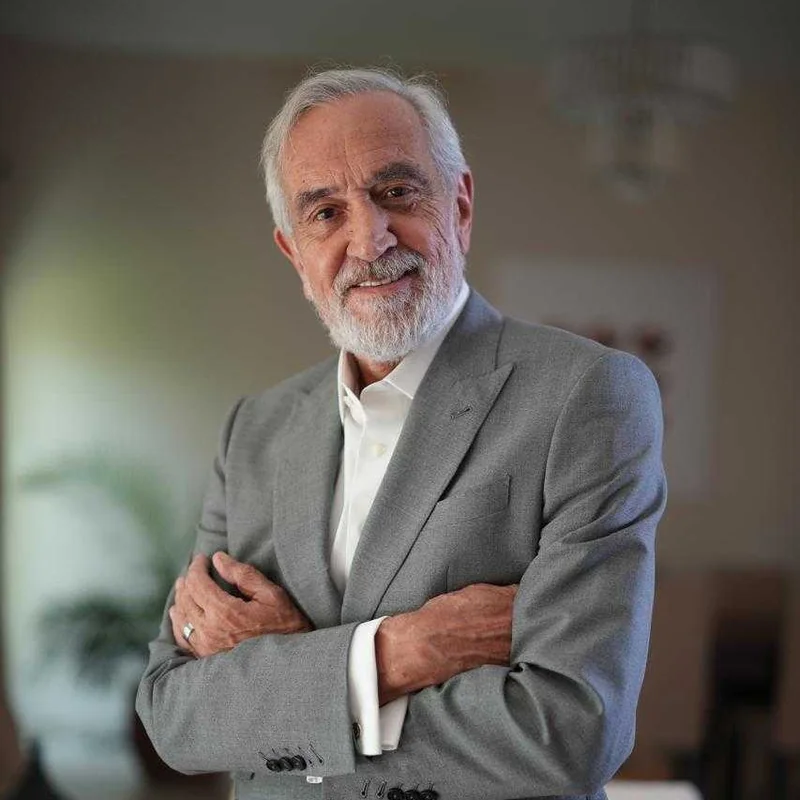
Franz B. Larsen, also known as François Larsen. Franz and François are the same name in German and French, and I answer to both. Founder of Saniservice, Dubai.

I know that because it happened to me.

Copenhagen

No doctor could find a solution.

I was born in Copenhagen. For six months of the year that city has almost no light and very high humidity, and that combination favours mold, which floats in the air whether or not anyone can see it.

For the first six years of my life I was ill for roughly five months of every year. At home, at the doctor's, or in hospital in an oxygen tent. My parents tried everything.

The mountains

Altitude and air.

My mother was Swiss, and she remembered something from her own youth. At the beginning of the last century, people who had been treated for tuberculosis were sent up into the Swiss mountains to sanatoriums, where they stayed for months at a time to recover their lung capacity. That was the whole treatment. Altitude and air.

She decided nothing more could be done in Denmark, and she sent me to a boarding school in the mountains.

Six months
the asthma was gone
Two years
completely cured

Within about six months the asthma was gone. Within two years it was completely cured.

I did not understand at the time that it was the air that had done it. I knew the air was better. I did not grasp that it had healed me. I spent the following decades travelling and working all over the world, in private banking, and it never came back. Not once.

The turning point

Dubai, 2007

Have you ever cleaned your air conditioning?

Then I moved to Dubai, and my asthma returned.

At first I blamed what everyone blames. The outdoor air, the pollution, the sand and the dust. It got worse until it became a crisis and I went to a doctor, who examined me, prescribed the antihistamines, and then asked me one question that redirected the rest of my life.

I had not. Coming from Switzerland, an air conditioner was a grille on a wall. I had no idea there was anything behind it.

The experiment

Could I recreate Swiss mountain air inside my own house?

So I set myself a problem: could I recreate Swiss mountain air inside my own house, and specifically in the room where I slept?

  1. I had the air conditioning properly deep cleaned.
  2. I had the whole house hygienised, because dust and humidity together are what produce mold, so the dust had to come out of every corner, not just the visible ones.
  3. I added air purifiers, of which there are very few genuinely good ones, though a few are excellent.

And I measured. I kept an index of air quality in Switzerland alongside an index for my own bedroom, so I could see whether I was actually reaching that standard or only believing that I was.

I reached it. My asthma went away again, and it has stayed away.

I still measure, in my own home, today.

Why this became a company

Anyone could wipe a grille.

In 2007 almost nobody in Dubai could do the part that mattered. Anyone could wipe a grille. Very few could open a system and treat it properly, which is an entirely different thing.

That was not a gap in the market. It was an insult to a standard I was not willing to lower. So in 2009 I built the company myself. Not to become the largest. To prove that quality is possible here.

Seventeen years on, we have served more than eleven thousand homes and businesses across the Emirates, and most of them come back with no contract obliging them to. We hold triple ISO certification, 9001, 14001 and 45001, audited by Bureau Veritas and never lapsed, along with NADCA certification for air-duct standards and IAC2 for mold. Those are checkable, which is the only reason to list them.

Seventeen
years
Eleven thousand
homes and businesses across the Emirates
Triple ISO
9001, 14001 and 45001
Bureau VeritasNADCAIAC2

Not to become the largest. To prove that quality is possible here.

Why there is a laboratory

Because of the child in the oxygen tent whom nobody could help, and because of the years when I was breathing better without understanding why.

I know what it costs to be told everything is fine by someone who has an interest in you believing it, and I know what it costs to be right without being able to prove it. So I built a microbiology laboratory in Al Quoz, which almost nobody in this field does.

It leads our mold remediation. It samples across our services to confirm our protocols are genuinely holding rather than merely written down. And it is open to any client who wants the air or the water in their own home tested with the numbers put in front of them.

I am precise about what that means, because precision is the entire point. We do not test every job every time and I will not claim we do. Our laboratory is not an accredited certifying body and I will not imply that it is. Where a result must carry formal certification we send it to a laboratory that holds that accreditation, and we say so.

What it gives us is simpler and worth more: the proof exists, it is ours rather than a subcontractor's, and you can ask for it.

In validation

The Oxidative Load Index®

I have been comparing an index of Swiss air against an index of my own bedroom since 2007. That habit never stopped. The Oxidative Load Index is what it became when it grew beyond one man and one room.

Here is the problem it exists to solve. Every air test in ordinary use counts particles. It tells you how much material is in the air and nothing at all about what that material is, or what it does when it reaches you. Two rooms can hold an identical particle count and place completely different burdens on the people inside them. One is close to inert. The other is chemically reactive, carrying metals, combustion residues and long-lived radicals that keep working long after the particle has settled.

For most people that is an abstraction. For me it is Copenhagen and the mountains, finally described properly. It is the difference between the rooms that made me ill and the air that healed me. Nobody could name that difference then. The instruments counted, and counting was never the thing.

So we are building a single measure of what the air in a space is actually doing, rather than how much of it there is.

It is our own framework, developed in-house, and it is still in validation. The science underneath it, that the reactive capacity of contaminants matters and not merely their quantity, is well established in environmental research. The particular way we resolve our readings into one number is ours, and it has not been externally validated or peer-reviewed. I will not call it either until it is.

I write about it while it is unfinished because I would rather show the working than imply a settledness it has not earned. That is not modesty. It is the same instinct as the laboratory. If I am asking you to trust a number, you are entitled to know precisely how far along it is.

What I write about, and why

Clean is not the goal. Clean is the floor.

I write about indoor environments because they have become my obsession. Private banking was the first one. This is the second, and it has lasted considerably longer.

The narrow description is indoor environmental quality: what is genuinely in the air, the water and the surfaces of a building in this climate, and how it can be measured rather than assumed.

The honest description is that I am obsessively curious about how far this can be pushed. Clean is not the goal. Clean is the floor. What holds my attention is whether a building can be made into something better than merely harmless, a place that actively restores the people inside it.

I know air can do that, because it happened to me. Two years in the Swiss mountains undid what six years of medicine in Denmark could not. But nobody engineered that. It was altitude, and the good fortune of a mother who remembered the sanatoriums. The mountains simply had that air; nobody had to build it.

That is the whole problem, and it is the one I have spent nineteen years on. Outdoors, in the right place, that air already exists. Indoors, where we now spend almost our entire lives, it has to be made. Deliberately, and against a climate that works against you at every turn.

A sanctuary of health. I am aware of how that sounds, and I would normally distrust anyone who said it. But mountain air healed me once, so I do not treat it as a slogan. I treat it as an engineering problem that almost nobody has taken seriously enough, and I would like to be one of the people who does.

And underneath all of it, a question that has occupied me just as long: the difference between excellence and mediocrity in service work, wherever it appears. Two ideas I keep returning to are the mathematics of mediocrity and the expectation economy.
Published work

Speaking and press

I have spoken at
WETEX in Dubai.

I am glad to talk to journalists working on indoor air, water quality or building health, and to speak where the subject is treated seriously.