Air
How I keep the air in my own home clean. It takes more than one device, and here is exactly what I use.
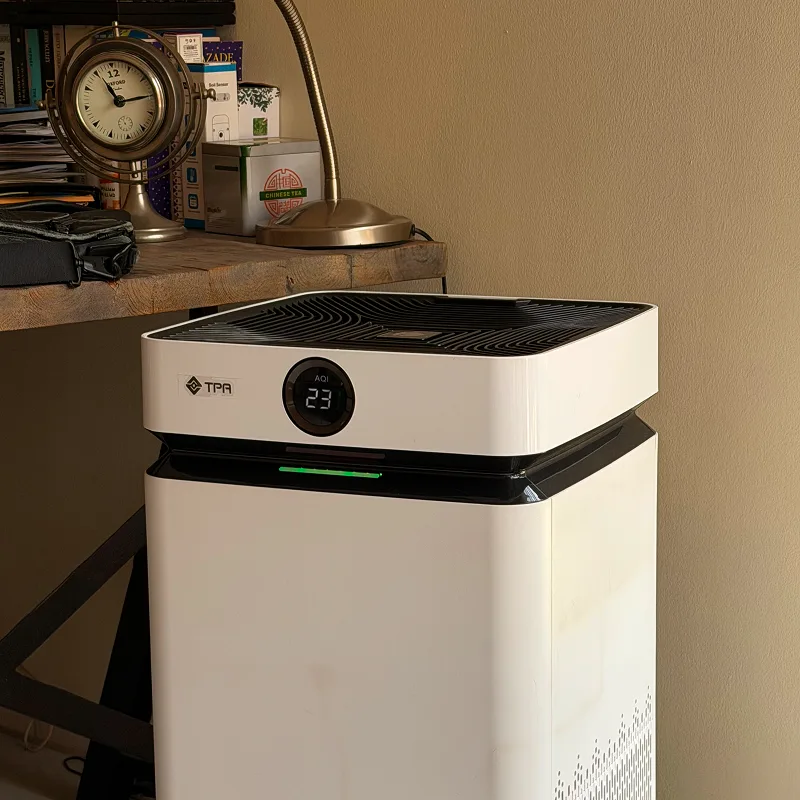
- What it is
- A medical-grade recirculating air cleaner, not just a consumer purifier. It actively treats airborne contaminants in a cold plasma field and collects them on washable metal plates, instead of straining them into a disposable HEPA filter.
- Why I use it
- It is FDA-cleared as a medical-grade air cleaner, it exchanges a room's air many times an hour, and it actively neutralizes airborne bacteria, mold spores and viruses rather than only trapping them. I feel the difference when it runs.
- One honest limit
- It cleans the air. It does not remove a hidden mold source, control humidity, or clean the dust already settled on your surfaces.
- My verdict
- For a closed, air-conditioned home where the same air is recirculated all day, I believe it is the best air technology you can own. I use it in mine.
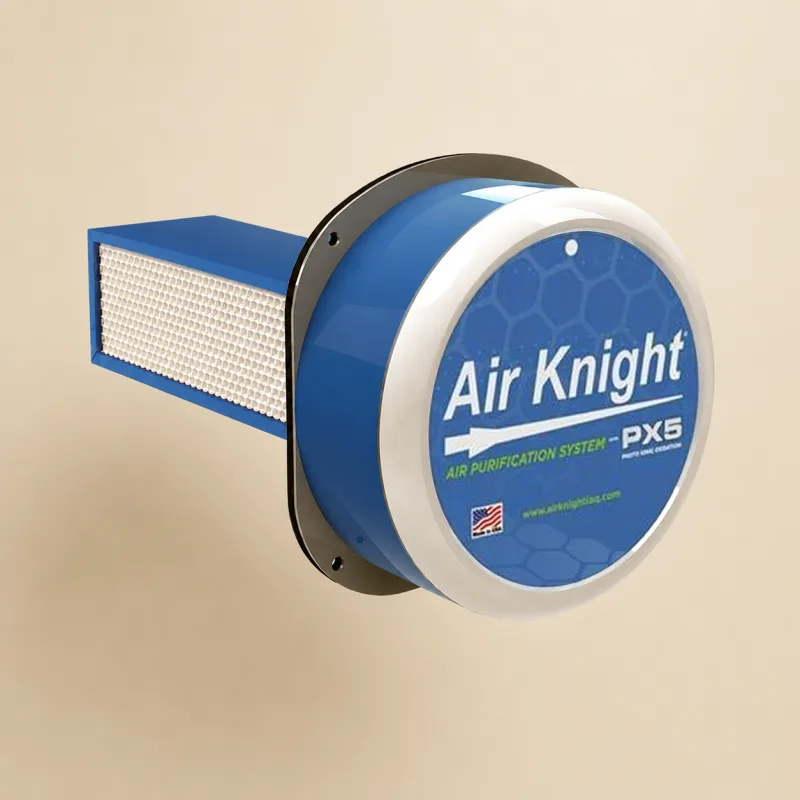
- What it is
- A different kind of device from the Airdog. Instead of drawing air in to clean it, Micropure sends active purifying molecules out through the air-conditioning, reaching the air and the surfaces that room air never passes through.
- Why I use it
- The Airdog cleans the air that reaches it. Micropure reaches the rest: the surfaces, the corners, the inside of the air-conditioning, the spaces between air changes. I run one in every air-conditioning unit in my home.
- The one thing I insist on
- Because it is an active technology, I use only a unit independently validated to emit effectively zero ozone. That is the single point my own history will not compromise on.
- My verdict
- On its own, excellent. Beside the Airdog, it is the complete answer. This is not the runner-up to the Airdog. It is its equal, doing the half of the job a filter cannot.
Why I use the Airdog TPA X8 PRO, in fullRead my full reasoning +Close −
Why I use it in my own home
The air around me has never been something I could take for granted. A sensitivity to it shaped much of my early life, and I learned, in the most personal way possible, that the air we breathe changes how we feel, how we sleep, and how we function. When that sensitivity resurfaced after I moved to Dubai, indoor air stopped being a professional interest and became personal. It is one of the reasons I founded Saniservice.
So when I chose an air purifier for my own family, I was not looking for the best known brand or the most beautiful appliance on a shelf. I wanted to know what a machine actually does to the air, how it treats what it cannot see, and where its limits are. After years of testing air technology professionally, I chose the Airdog TPA X8 PRO.
I am convinced it is, by a wide margin, the best air purification technology you can put in a home like mine.
The problem I wanted to solve
A modern Dubai home is closed and air-conditioned almost all year. Fine desert dust works its way inside, while cooking, allergens, pet dander and biological material are generated within. The air-conditioning then carries all of it around the home again and again. Cleaning the AC helps, but microbes regrow on and through the filters and are blown back into the rooms. This is the cycle I wanted to break in my own home: not simply to strain out dust, but to continuously reduce the living contaminants, the bacteria, the mold spores and the viruses in the air, that ordinary purifiers leave behind.
Why I am convinced it is the best
Most purifiers are passive. They pull air through a HEPA filter and trap particles. A good HEPA filter does that job well, but it does nothing to the biology it holds, and in our climate it clogs with dust and loses airflow until you replace it.
The Airdog works differently. Room air first passes through a cold plasma field that charges and neutralizes airborne microorganisms down to about 15 nanometers, far smaller than a single virus. Those charged particles are then drawn onto washable metal collector plates rather than a disposable filter, and a carbon stage handles odors. It combines active treatment with physical collection, and the plates simply wash and go back in. No consumables, no falling airflow, no waste.
The finding that convinced me most: in laboratories already running HEPA filtration, adding the Airdog reduced the airborne bacteria and fungi further still. It cleaned air that was already considered clean.
Why it matters to me personally: medical-grade, and always moving the air
Two things about this machine matter to me more than they might to most, because I have spent my whole life attentive to the air around me.
The first is that it is not simply a consumer purifier. It is cleared by the US FDA as a medical-grade recirculating air cleaner, a regulated device category with a defined standard to meet, and it is CE certified for Europe. Most familiar brands, however well made, are consumer air purifiers with no such classification. When it is the air I breathe at night, I want the device that had to prove itself to a medical regulator, not the one that only had to look good on a shelf.
The second is how much air it actually moves. A rating on a box means little if the machine treats a room's air only once or twice an hour. This one moves enough air to pass the entire volume of a room through its treatment many times over, every hour. That constant, high rate of exchange is, I am convinced, the reason I can genuinely feel the difference when it runs.
I do not keep one unit for the whole house. I run several, so the rooms where my family actually spends time, our bedrooms and our living room, are each being cleaned continuously, not in turn.
The evidence that convinced me
I do not ask you to take my word for it, and I did not take the manufacturer's word for it either. This is the most thoroughly tested air technology I have ever put my name to.
- Our own lab. Saniservice ran the unit in a mold-affected Dubai villa and took viable air samples before and after 48 hours. The culture plates showed a clear drop in living airborne mold and bacteria, in a real home, under the conditions our clients actually live in.
- Dubai Central Laboratory, Dubai Municipality. The government laboratory measured reduction of bacteria, yeast and mold in a live room test (report TR-0138-2024).
- Central Veterinary Research Laboratory, Dubai (Prof Ulrich Wernery). Independently recorded a striking reduction of airborne bacteria and fungi, even in labs already cleaned by HEPA filters.
- AstraGene molecular diagnostics. In a certified clean room, the Airdog reduced particles and germs further still, and cut their HEPA replacement costs.
- Independent chamber testing to the NHS Liverpool biovalidation protocol. An average bacterial reduction of 99.8% across repeated runs in a controlled test chamber. The protocol originates with NHS Liverpool; the NHS did not conduct or endorse this testing.
- Gulf Medical University. an ethics-approved study recording a substantial reduction in airborne bacteria under test conditions.
- US FDA and CE. The model holds US FDA 510(k) clearance (K240696) as a Class II medical recirculating air cleaner, and is CE certified for Europe. FDA-reviewed testing showed it inactivates H3N2 influenza virus in the air and reduces Staphylococcus albus bacteria by 99.99% at full speed.
No consumer air purifier I know of carries this weight of independent, government and clinical-grade testing. None of it means a purifier prevents illness, and I would never claim that. What it means is that the air itself carries measurably less biological load, and that is exactly what I wanted for my family.
Why I chose it over Dyson
Dyson makes beautiful, well-engineered purifiers, and HEPA filtration genuinely works. My choice was about priorities. I wanted active treatment of airborne biology, not only capture. I wanted enough clean air for a large room, washable plates instead of an endless stream of disposable filters, and performance built for continuous use in a dusty climate. If your first concern is formaldehyde, gases or design, a Dyson may suit you better. For biological air quality in a large, air-conditioned home, nothing I tested came close to the Airdog.
What it is, and what it is not
I believe in it precisely because I stay honest about it. So here is where it stops:
- It cleans the air, it does not fix a hidden mold source. If mold is growing inside a wall or your air-conditioning, the moisture has to be corrected and the material properly remediated.
- It does not control humidity or bring in fresh air. High humidity, condensation and ventilation need their own solutions.
- It does not clean what has already settled. Dust and allergens on mattresses, carpets and surfaces still have to be physically removed.
- It asks for a little care. The plates are washed and fully dried, more often here than in cooler climates. It is a machine you maintain, not one you forget.
- It produces only a very low level of ozone as a by-product of its process, well below recommended limits and absorbed by the carbon stage. Because of my own history, I would not use it otherwise.
It is one layer, the air layer, within a complete home environment. A powerful one, but one layer.
It does not replace cleaning your AC. It protects it.
Let me be clear about how this sits alongside the work we do. An air purifier does not replace a professional air-conditioning cleaning, and I would never present it as one. If your system is already contaminated, it has to be cleaned properly first. What the Airdog does is protect that investment afterward.
Remember the cycle I described in a closed home: dust and biological material settle into the air-conditioning, grow on and through the filters, and are blown back into the rooms. By continuously pulling those contaminants out of the air before they reach and feed the system, the purifier slows the rate at which your AC becomes dirty again. The air stays cleaner, and the cleaning you paid for lasts longer. That is why I see the two as partners, not alternatives: clean the system, then keep it clean.
About the price, and the size
I will not pretend it is cheap, and I will not pretend it is small. It is a serious machine, close to 20 kilograms, and it costs more than a typical purifier. If you want the best, it carries the price of the best. But look honestly at what you pay over time. A filter-based purifier keeps costing you: you buy replacement filters again and again for as long as you own it, and over a few years those filters can quietly add up to more than the price of a machine that needs none.
The Airdog has no filters to buy, ever. You wash the metal collector plates and put them back. You pay once for the device, and after that the running cost is close to nothing, with nothing going to landfill. Seen across the life of the machine, I consider it the more economical choice, not the more expensive one. As for the size, it earns its place. That volume is what lets it move enough air to genuinely clean a large room, rather than just the corner it stands in.
One more thing worth knowing. This is a professional unit, the kind specified for offices, clinics and commercial spaces. You will not find it on the usual online stores, because it is not a consumer product. I use it at home for a simple reason: I wanted the most powerful air cleaning I could place in the rooms where my family actually lives, and I was not willing to settle for the domestic version of the idea.
If your room is smaller
TPA makes a full range, including smaller units built for smaller spaces, so there is an honest option for a compact bedroom, a study or a nursery, and for a smaller budget. If that is what you need, it is a good choice, and we are glad to guide you to the right size.
But you are here for my opinion, so I will give it. I almost always recommend going for the most capable unit a room can take, often a step above what the square meters suggest. For the reason I gave earlier: what keeps a room consistently clean is how often its air is exchanged through the machine, not whether it covers the space on paper, and a more powerful unit does that far more often. When it comes to the air my family breathes, I would rather have it cleaned many times over than just enough.
My conclusion
I use the Airdog TPA X8 PRO because, after everything I have seen, professionally and personally, I am convinced it is the finest air cleaning technology you can bring into a home. It gives my family cleaner air every hour of the day, quietly, without waste, and with proof behind it that I have checked myself. If you do only one thing for the air your family breathes, I believe this is where to start. And if you want the complete answer, you pair it with the second device I trust just as much, which I come to now.
Why I run Micropure, in fullRead my full reasoning +Close −
Why one device was never going to be enough
The Airdog is a powerful machine, but it has one honest boundary that no filter can cross: it can only act on the air that physically reaches it. Air in the far corner of a room, air resting against a wall, and every surface in the home, the counters, the door handles, the bedding, sit outside its reach until that air happens to circulate through it. In the hours between air changes, contaminants settle and surfaces stay untouched. I wanted something working on all of it, all of the time.
What Micropure does differently
Micropure is built on ActivePure, a photocatalytic technology first developed from NASA research for the International Space Station. Rather than waiting for air to come to it, it continuously generates active purifying molecules and releases them, in most installations through the air-conditioning, so they travel with the moving air into every room and settle across surfaces. Those molecules seek out and neutralize bacteria, mold and viruses in the air and on the surfaces they reach, then revert to ordinary, harmless components of air.
The Airdog removes what reaches it. Micropure reaches what a machine never will. That is the whole idea, and it is why I stopped thinking of air as a single-device problem.
The evidence that convinced me
As with the Airdog, I did not take this on the manufacturer's word. The ActivePure technology Micropure is built on has been tested by serious, independent laboratories.
- University of Texas Medical Branch (UTMB). In a biosafety level 3 and 4 laboratory that works for the US military and the CDC, ActivePure inactivated more than 99.9% of airborne SARS-CoV-2 virus in an enclosed chamber within about three minutes, under FDA-compliant protocols.
- MRIGlobal, an independent FDA-compliant laboratory. Recorded a 99.98% reduction of live virus on surfaces over seven hours. This is the result that matters most to me, because it proves the part the Airdog cannot do: it works on surfaces, not only the air.
- Peer-reviewed. Results for ActivePure have been published in the Journal of Infection and Public Health.
- Its origin. The core technology grew out of NASA research for the International Space Station, where clean air and clean surfaces are not a convenience.
These tests were run on ActivePure units under laboratory conditions, and they describe reduction of contaminants in the air and on surfaces, not the prevention of any illness. I would never claim otherwise. What they told me is that the technology genuinely does what it says, in the two places I care about: the air, and everything the air touches.
On ozone, the one thing I insist on
Any active technology has to answer one question honestly, and it is the question I care about most: does it produce ozone. My own sensitivity will not tolerate it. So I use only a Micropure unit independently validated to emit effectively zero ozone, to the UL 2998 standard, which sets the bar at one tenth of the regulatory limit. The active molecules do their work and then break down back into normal air. This is not a detail I am relaxed about. It is the reason I am comfortable running it in the rooms where my family sleeps.
What it is, and what it is not
It earns its place precisely because I am clear about its edges:
- It is not a filter, and does not collect dust. It will not capture the visible dust and particles the Airdog pulls in and holds. That is the Airdog's job, not this one.
- It does not replace the Airdog, and the Airdog does not replace it. Removal and active reach are two different jobs. I want both, which is the entire point of this page.
- It works with your air-conditioning. In the usual installation it distributes through the system, so it does its best work when the air is moving through the home.
- It must be the correctly specified, validated unit, maintained as intended. An active technology is only as good as the unit and its certification, which is why I insist on the zero-ozone validation above.
My conclusion
I run Micropure because it does the half of the job a filter cannot. It reaches the air a machine never pulls in, and the surfaces a machine never touches, quietly and continuously, from inside the system that already moves air through my home. On its own it is an excellent device. Next to the Airdog, it is, to me, the complete answer for the air my family lives in.
These are my two recommendations for air, and I hold them equally. The Airdog moves and cleans a large volume of air many times an hour and collects what it removes. Micropure keeps working on the air and the surfaces in between, from inside the air-conditioning. One removes, the other reaches. Each is excellent alone. Together, with the air-conditioning system kept properly clean underneath them, they are the closest thing I have found to a complete answer, and it is exactly the setup I live with at home.