


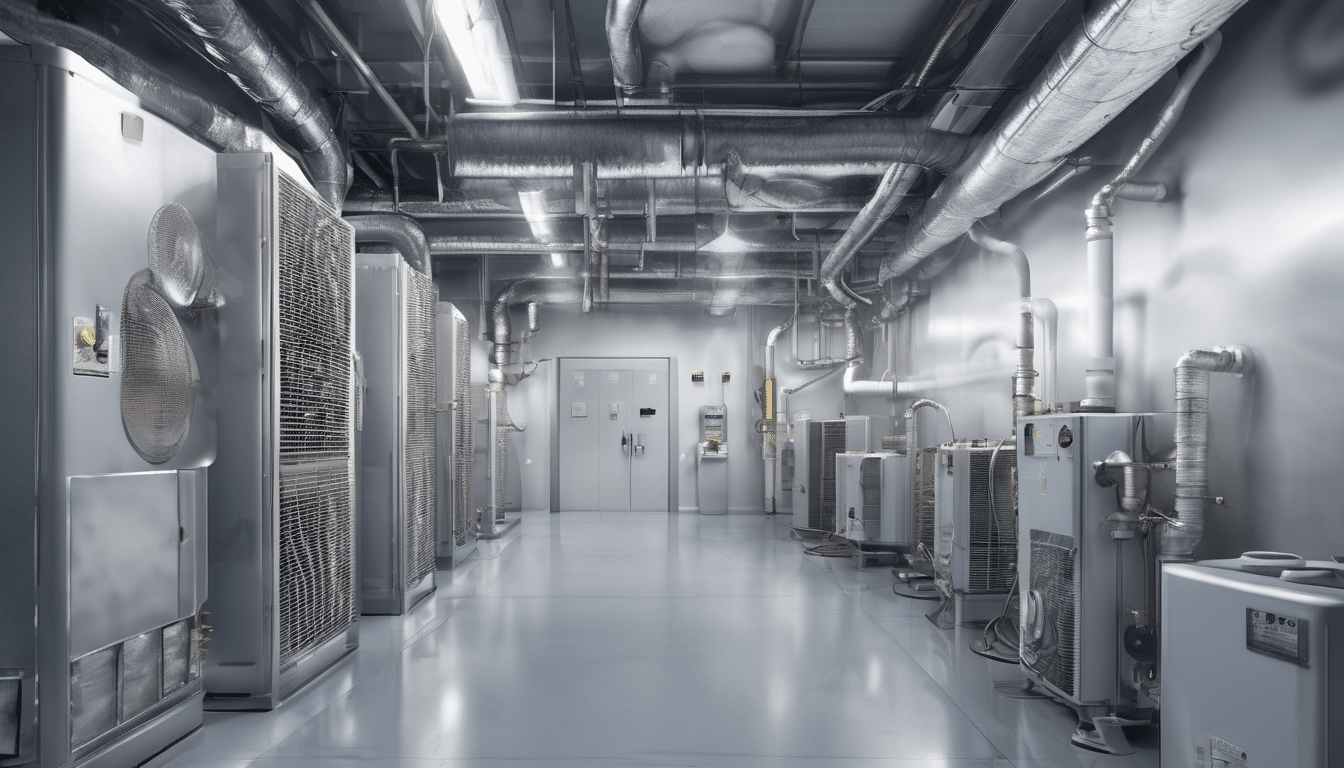
Impact On Particulate: Hvac Design, Filtration Efficiency
In air conditioned buildings across Dubai, Abu Dhabi and the wider UAE, HVAC Design, Filtration Efficiency And Their Impact On Particulate Levels determine whether PM2.5 and PM10 stay within healthy ranges or drift into problem territory. In a climate where buildings are sealed for much of the year and occupants rely almost entirely on mechanical systems, the way the HVAC is designed, filtered and operated directly shapes indoor particulate profiles.
This supporting article sits alongside the main case study on Analyzing Particulate Matter Monitoring (PM2.5/PM10) Challenges in Modern Buildings and focuses specifically on how HVAC architecture, filter performance and airflow strategies influence what your particle monitors actually measure. Understanding this linkage is critical if you want PM data to guide effective interventions rather than just documenting problems. This relates directly to Hvac Design, Filtration Efficiency And Their Impact On Particulate Levels.
Drawing on building science, HVAC engineering practice and field experience in UAE projects, we will unpack how design intent, equipment selection, filtration rating, pressure drops and operating strategies collectively drive particulate accumulation or control in real buildings.
Table of Contents
- The role of HVAC systems in particulate transport and removal
- HVAC Design, Filtration Efficiency And Their Impact On Particulate Levels
- Filter ratings, mechanisms and practical limits in UAE systems
- Airflow, recirculation and clean air delivery for PM2.5/PM10
- Duct design, leakage and distribution effects on particulates
- Control strategies, maintenance and their impact on PM trends
- Integrating HVAC design and filtration with PM monitoring programmes
- Key takeaways
- Conclusion
The role of HVAC systems in particulate transport and removal
In a typical UAE building, the HVAC system is both a transport mechanism and a control mechanism for particulates. Supply air diffusers, return grilles and transfer paths move airborne particles between zones, while filters in air handling units (AHUs), fan coil units (FCUs) or package units remove a fraction of those particles on each pass.
From a building science perspective, three simultaneous processes govern indoor PM2.5/PM10 behaviour:
- Generation from indoor sources (occupants, cleaning, cooking, construction, parking areas)
- Ingress from outdoor air through ventilation intakes, infiltration and door openings
- Removal by filtration, deposition on surfaces and exhaust ventilation
Poorly designed or undersized HVAC systems often have inadequate filtration stages, low face velocities but limited effective capture, or insufficient recirculated volumes to meaningfully reduce PM2.5/PM10. Conversely, well designed systems use filtration and air distribution to progressively reduce indoor concentrations, strongly influencing the monitoring results discussed in Analyzing Particulate Matter Monitoring (PM2.5/PM10) Challenges in Modern Buildings.
HVAC Design, Filtration Efficiency And Their Impact On Particulate Levels
When we talk about HVAC Design, Filtration Efficiency And Their Impact On Particulate Levels, we are really asking how early design decisions lock in the building’s baseline ability to control PM. Several elements matter simultaneously:
- System type (centralised AHUs with ducted distribution vs decentralised FCUs or split units)
- Location of filters (central plant, local fans, terminal units, dedicated filtration units)
- Available fan static pressure to support higher efficiency filters without starving airflow
- Air change rates and recirculation fractions at design conditions
- Fresh air intake placement relative to outdoor particle sources (roads, loading bays, desert dust)
In many Dubai towers and villas, the original HVAC design assumed low to medium efficiency filters, prioritising energy and first cost over fine particulate control. Retrofitting higher efficiency filtration then becomes constrained by limited fan capacity and tight filter sections. As a result, PM2.5 readings from indoor monitors can remain elevated even after “upgrading” filters, because the system was never engineered for the associated pressure drops or required clean air delivery rates. When considering Hvac Design, Filtration Efficiency And Their Impact On Particulate Levels, this becomes clear.
From a design standpoint, there is a direct chain linking coil selection, fan curves, duct sizing, filter depth, and ultimate particulate outcomes. Oversimplifying any one of these issues means particle monitors will later reveal persistent PM2.5/PM10 problems that cannot be solved by filtration alone.
HVAC Design, Filtration Efficiency And Their Impact On Particulate Levels through filter ratings
A core part of HVAC Design, Filtration Efficiency And Their Impact On Particulate Levels is the choice of filter rating and media type. Globally, the Minimum Efficiency Reporting Value (MERV) scale is widely used, with higher MERV numbers capturing a higher fraction of smaller particles. In practice:
- MERV 6–8 filters primarily capture large dust and lint, with limited effect on fine PM2.5
- MERV 11–13 filters substantially increase capture of 1–3 μm particles, the range where PM2.5 dominates
- MERV 14–16 or HEPA-like systems provide even higher efficiencies, but at higher pressure drops and cost
Research has repeatedly shown that upgrading from basic fibreglass or low-MERV filters to high efficiency media can cut indoor PM2.5 and PM10 by significant margins when fans operate sufficiently. However, this only holds if: The importance of Hvac Design, Filtration Efficiency And Their Impact On Particulate Levels is evident here.
- The filter is properly sealed to prevent bypass
- The media face velocity is within design range
- Fan capacity can handle the higher resistance without unacceptable airflow loss
In UAE buildings, it is common to see nominally “high efficiency” filters installed in one inch sections that were originally sized for MERV 8. The resulting pressure drop reduces airflow, compromises coil performance, and may even reduce the effective clean air delivery rate for PM2.5/PM10. In such cases, PM monitors record little net improvement because the filtration upgrade was not matched with appropriate mechanical and design allowances.
HVAC Design, Filtration Efficiency And Their Impact On Particulate Levels via airflow and recirculation
Clean air delivery depends not only on filter efficiency but also on how much air actually passes through the filter per hour. This is where HVAC Design, Filtration Efficiency And Their Impact On Particulate Levels intersect with airflow and recirculation strategies.
Key parameters include:
- Total supply airflow (L/s or m³/h)
- Recirculation ratio vs outdoor air fraction
- Duty cycle of fans (continuous vs intermittent operation)
- Air distribution effectiveness and mixing within zones
A high-efficiency filter with very low airflow or a fan that only operates sporadically will provide minimal overall PM reduction compared to a moderately efficient filter operating continuously with high recirculation. In sealed UAE buildings, operating fans in a “clean air” mode, even outside active cooling demand, can substantially reduce PM2.5/PM10 by repeatedly passing indoor air through the filters.
From a particulate control perspective, it is therefore useful to think in terms of equivalent clean air changes per hour provided by HVAC recirculation plus filtration. This lens is exactly what you need when interpreting data plots in Analyzing Particulate Matter Monitoring (PM2.5/PM10) Challenges in Modern Buildings: rapid decay curves after a particle event usually indicate strong recirculated filtration and mixing, whereas flat curves suggest poor airflow, low efficiency filters, or both.
Duct design, leakage and distribution effects on particulate levels
Even with good central filtration, duct design and integrity significantly affect particulate behaviour. Several mechanisms are important in the UAE context: Understanding Hvac Design, Filtration Efficiency And Their Impact On Particulate Levels helps with this aspect.
- Duct leakage in return shafts or ceiling voids can draw in dust from service cavities, bypassing filters
- Unlined or contaminated ducts can act as reservoirs, re-entraining settled particles during fan operation
- Poor diffuser placement can create zones of low air movement where PM2.5 lingers
- Unbalanced systems may cause certain rooms to be consistently under-served with clean air
In villas and apartments around Dubai and Sharjah, it is common to see PM10 spikes related to duct leakage from dusty ceiling voids or parking-level shafts. In commercial towers, badly sealed return air plenums above suspended ceilings can pull in construction dust, undoing much of the work done by central filters. Monitoring campaigns often reveal that certain rooms show consistently higher particulate levels than others, which, upon investigation, often link back to distribution design flaws rather than filter efficiency alone.
Therefore, when you see unexpected spatial patterns in particulate maps during a campaign, you must evaluate duct integrity, leakage paths and diffuser layouts in parallel with filtration settings.
Operation, control and maintenance impacts on particulate trends
How the HVAC system is controlled day to day often has as much impact on PM2.5/PM10 as the original design. Common operational factors in UAE buildings include: Hvac Design, Filtration Efficiency And Their Impact On Particulate Levels factors into this consideration.
- Fan schedules that switch off outside occupied hours, allowing particulates to accumulate overnight
- Weekend shutdowns in offices that cause Monday morning PM spikes
- Night setback modes in residential buildings that reduce recirculation and air cleaning
- Filter change intervals extended beyond design due to cost or logistics
A clogged filter increases resistance, which reduces airflow and can alter pressure relationships, potentially pulling more unfiltered air from leakage paths. In addition, poor filter sealing after maintenance can create bypass paths where a large portion of air avoids the media altogether, severely degrading effective filtration efficiency.
When we overlay PM2.5/PM10 monitoring data with BMS trend logs of fan status, valve positions and differential pressure across filters, recurring particulate patterns often align tightly with control schedules and maintenance events. Such integrated analysis is vital to move from merely Analyzing Particulate Matter Monitoring (PM2.5/PM10) Challenges in Modern Buildings to actually resolving them with targeted changes to operation and maintenance regimes.
Integrating HVAC design and filtration with PM monitoring programmes
To get full value from a particulate monitoring programme, PM2.5/PM10 data must be interpreted through the lens of HVAC Design, Filtration Efficiency And Their Impact On Particulate Levels. This integration avoids the common trap where air quality sensors are installed, issues are identified, but corrective actions are ineffective because they ignore mechanical constraints.
A robust approach in UAE projects typically includes:
- Baseline HVAC assessment: system type, filter ratings, fan capacities, duct layout, outdoor air pathways
- Operational review: schedules, fan cycling, setpoints, filter change procedures
- PM monitoring strategy: sensor placement in relation to supply and return patterns
- Data correlation: relating PM trends to HVAC state (on/off), occupancy, and outdoor events (sandstorms, traffic peaks)
- Iterative interventions: trial changes to filtration, fan run times, outdoor air fractions, followed by post-change PM tracking
This cycle turns raw PM2.5/PM10 readings into actionable engineering decisions: whether to increase recirculation, adjust filter depth, seal duct leaks, relocate intakes, or deploy supplemental room air cleaners in specific high-load zones such as lobbies, basement car parks interfaces, or smoking-adjacent areas.
With this systems view, particulate monitoring becomes a diagnostic tool embedded within the broader framework of HVAC and building performance, rather than a disconnected environmental metric. This relates directly to Hvac Design, Filtration Efficiency And Their Impact On Particulate Levels.
Key takeaways
- HVAC Design, Filtration Efficiency And Their Impact On Particulate Levels are inseparable from PM2.5/PM10 monitoring outcomes in UAE buildings.
- Filter efficiency alone is insufficient; clean air delivery depends on airflow rates, duty cycles and proper sealing.
- Duct leakage, return air strategies and diffuser layouts can create local particulate hotspots despite good central filtration.
- Operational factors such as fan schedules and filter maintenance strongly modulate day to day PM trends.
- Effective control of particulates requires integrating HVAC assessment with the analytical insights from Analyzing Particulate Matter Monitoring (PM2.5/PM10) Challenges in Modern Buildings.
Conclusion
In the sealed, mechanically cooled environments of Dubai, Abu Dhabi, Sharjah and the wider UAE, HVAC Design, Filtration Efficiency And Their Impact On Particulate Levels are foundational determinants of indoor air quality. PM2.5 and PM10 are not random; they respond in predictable ways to filter selection, fan operation, duct integrity and outdoor air strategies embedded in each project.
By deliberately linking particulate monitoring data to HVAC engineering decisions, building owners and consultants can move beyond passive observation to active optimisation. This supporting article complements the main case study on Analyzing Particulate Matter Monitoring (PM2.5/PM10) Challenges in Modern Buildings by showing that the smartest sensors in the world cannot compensate for poorly designed or poorly operated mechanical systems. True progress comes from aligning monitoring, filtration and design into a coherent indoor environmental strategy. Understanding Hvac Design, Filtration Efficiency And Their Impact On Particulate Levels is key to success in this area.

JV de Castro
JV de Castro is the Chief Technology Officer at Saniservice, where he leads innovation in indoor environmental sciences, IT infrastructure, and digital transformation. With over 20 years of experience spanning architecture, building science, technology management, digital media architecture, and consultancy, he has helped organizations optimize operations through smart solutions and forward-thinking strategies. JV holds a Degree in Architecture, a Masters of Research in Anthropology, an MBA in Digital Communication & Media, along with certifications in mold, building sciences and building technology. Passionate about combining technology, health, and sustainability, he continues to drive initiatives that bridge science, IT, and business impact.

Leave a Reply