


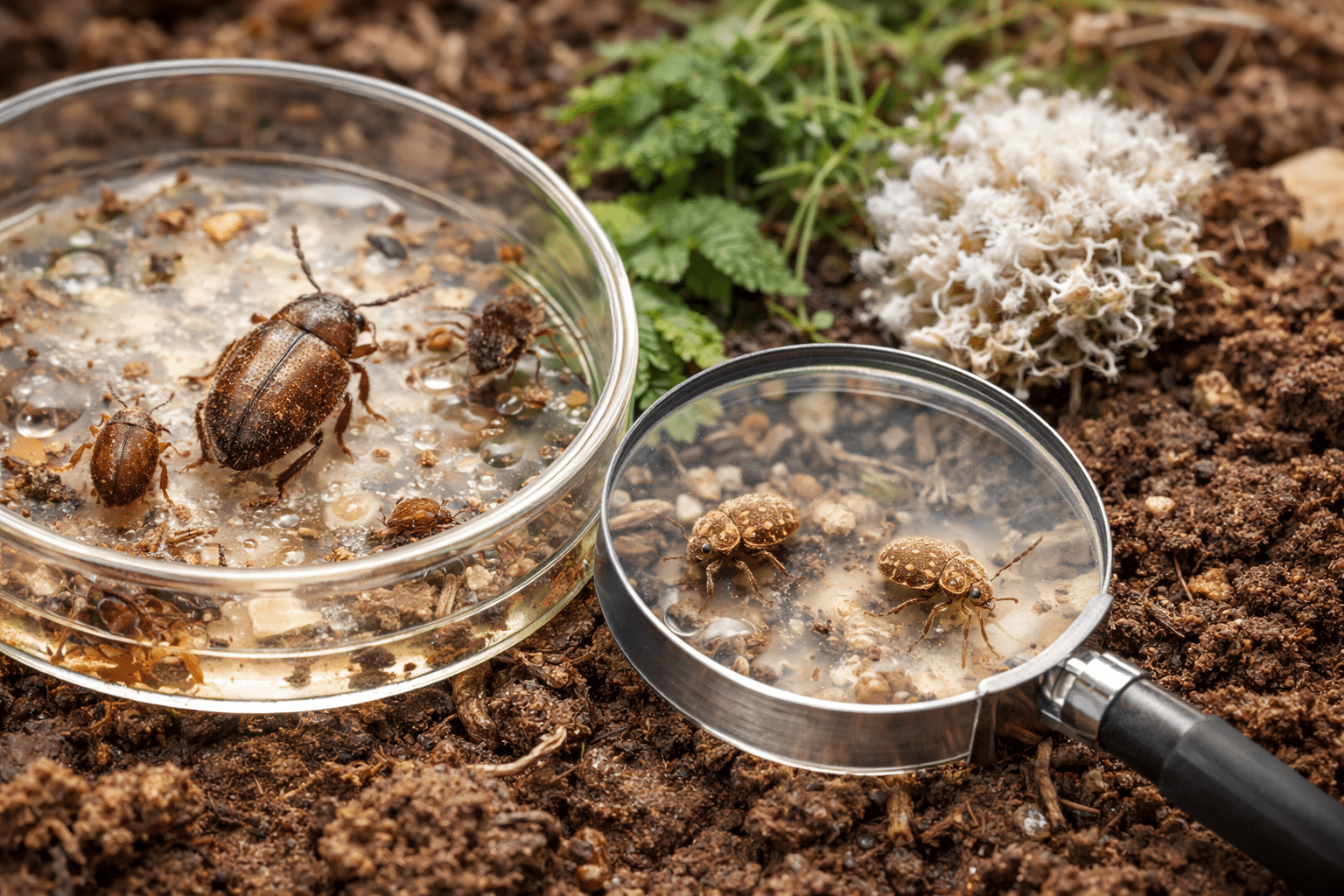
Environmental Determinants of Cryptophagidae and Latridiidae Population Dynamics in Residential Indoor Environments
If you’ve been noticing small brown beetles appearing behind your bed, along your carpet edges, or near your wardrobes, your first instinct might be to call pest control. But before you reach for the insecticide, consider this: those tiny beetles might be delivering an important message about your indoor air quality.
At Saniservice Indoor Sciences Division, we recently completed a comprehensive study examining the relationship between specific beetle species and hidden mold problems in Dubai homes. The findings have significant implications for anyone concerned about the air quality in their living spaces.
Meet the Messengers: Cryptophagidae and Latridiidae
The beetles in question belong to two families: Cryptophagidae (silken fungus beetles) and Latridiidae (minute brown scavenger beetles). These tiny insects, typically measuring just 1–3 mm in length, share one critical characteristic that makes them invaluable indicators of indoor environmental problems.
They are obligate fungivores.
This scientific term means they literally cannot survive without feeding on fungal growth. No mold, no beetles. It’s that simple.
Unlike generalist pests that can feed on various food sources, these beetles have evolved to depend entirely on fungi for their survival and reproduction. When you find them concentrated in specific areas of your home, they’re essentially pointing directly at a hidden mold problem.
The Dubai Factor: Why This Matters Here
Dubai’s climate creates a perfect storm for hidden moisture problems in homes. The combination of:
- Extreme outdoor temperatures (often exceeding 45°C)
- High ambient humidity, especially during summer months
- Heavy reliance on air conditioning
- Furniture placement against external walls
…creates conditions where moisture can accumulate in hidden spaces without any visible signs.
When your AC cools your room to a comfortable 22°C while the external wall has absorbed heat all day, a significant temperature differential develops. Place a bed or wardrobe against that wall, and you’ve created what building scientists call a “dead zone” — a stagnant air pocket where humidity accumulates and mold can thrive unseen.
What Our Research Revealed
Our study examined six residential properties across Dubai — from villas in Jumeirah and Palm Jumeirah to apartments in Marina, Downtown, and JLT. Each property reported concentrated beetle activity in bedroom areas, particularly around fabric headboards and carpet edges.
Strong correlation between ventilation and beetle populations
Properties with poor air circulation (below 0.35 air changes per hour) showed significantly higher beetle numbers. The statistical correlation was striking: r = -0.85, meaning as ventilation decreased, beetle populations increased proportionally.
Hidden humidity zones exceed safe levels
While room-center humidity readings appeared acceptable (49–61%), the microenvironments behind furniture told a different story. Humidity levels in these hidden zones ranged from 66% to 82% — well above the 65% threshold where mold begins to grow.
The differential is dramatic
On average, the humidity behind furniture was 18 percentage points higher than at room center. In the worst case, we documented a 28-point differential — essentially tropical rainforest conditions hidden behind a headboard while the room felt perfectly comfortable.
Environmental correction works
By addressing the root cause — improving ventilation, repositioning furniture, and managing humidity — we achieved an average 91.3% reduction in beetle populations within 30 days. No pesticides required.
What This Means for Your Home
If you’re finding these beetles in your home, particularly concentrated in specific areas, consider it an early warning system. These insects are detecting fungal growth that you cannot see, smell, or measure with basic equipment.
The beetles are not the problem. They’re the symptom.
Spraying insecticide might eliminate the visible beetles temporarily, but without addressing the underlying moisture and ventilation issues, they will return. More importantly, the mold that’s feeding them will continue to grow, potentially affecting your indoor air quality and, over time, your health and your property.
The Right Response
When clients contact us about beetle infestations, we don’t start with pest control. We start with questions:
- Where exactly are the beetles concentrated?
- Is your bed positioned against an external wall?
- Do you keep your bedroom door closed?
- Have you noticed any musty odours?
- What temperature do you set your AC to?
These questions help us understand the building science dynamics at play. From there, a proper investigation examines thermal gradients, microenvironment humidity, air movement patterns, and potential fungal colonisation sites.
The solution typically involves environmental modification — not chemical treatment. Repositioning furniture, improving air circulation, managing humidity levels, and addressing any underlying moisture sources.
Download the Complete Study
We’ve published our complete research findings, including the full methodology, detailed case data, and a diagnostic investigation protocol for indoor environmental professionals.
The study includes:
- Complete environmental assessment data from all six case studies
- Statistical analysis of ventilation, thermal gradients, and beetle populations
- A validated five-phase investigation protocol
- Threshold reference tables for field use
- Root cause decision matrix
- Remediation outcome data
Whether you’re an indoor air quality professional, a building manager, a concerned homeowner, or simply curious about the science behind indoor environmental quality, this research provides valuable insights into an often-overlooked indicator of hidden mold problems.
Download the Complete Research Study (PDF)
Need an Assessment?
If you’re experiencing a fungus beetle issue in your Dubai home or property, or if you’re concerned about hidden moisture and mold problems, our Indoor Sciences Division can help.
We conduct comprehensive indoor environmental assessments using thermal imaging, moisture mapping, microenvironment humidity measurement, and air quality analysis to identify root causes and develop effective solutions.
Contact Saniservice Indoor Sciences Division
JV de Castro, CIEC, CMI, CMRS, CIE
Director of Indoor Sciences
Saniservice LLC, Dubai

JV de Castro
JV de Castro is the Chief Technology Officer at Saniservice, where he leads innovation in indoor environmental sciences, IT infrastructure, and digital transformation. With over 20 years of experience spanning architecture, building science, technology management, digital media architecture, and consultancy, he has helped organizations optimize operations through smart solutions and forward-thinking strategies. JV holds a Degree in Architecture, a Masters of Research in Anthropology, an MBA in Digital Communication & Media, along with certifications in mold, building sciences and building technology. Passionate about combining technology, health, and sustainability, he continues to drive initiatives that bridge science, IT, and business impact.

Leave a Reply